Monday, November 17, 2014

Flu Season is Upon Us

The inevitable flu season. It comes back to get us every year. Luckily, there are many easy ways to help protect yourself this season, and most methods should sound familiar; thorough hand washing, a mix of rest and regular physical activity, and lots of vitamin C are great habits for staying healthy no matter what the season is. Other simple preventative measures include avoiding direct contact with your eyes, nose, and mouth, as well as avoiding close interaction with others who may be sick. And of course, it’s important to get vaccinated to prevent a run in with the flu, but did you know there’s another preventative measure out there?

A routine eye exam is one way that flu symptoms may be detected before they become severe. In the early stages of any virus, symptoms may be less detectable, but there a number of subtle signs in the eyes that can be an early indication of a virus like the cold or flu. Doctors can look underneath your eyelids for a papillary reaction. A papillary reaction looks like goose bumps with redness and irritation, all things that indicate a patient is symptomatic. Besides early detection of viruses like the cold or flu, eye exams can also detect signs of other health problems such as diabetes, glaucoma, or heart disease. Early detection of a variety of illnesses is just another great reason to see your eye doctor at least once a year. Call us today to beat flu and cold season!

Monday, November 10, 2014

The Story on Watery Eyes

It’s safe to say tears play an important role in keeping us healthy. Tears keep the surface of our eyeballs clean and moist, and help protect our eyes from damage. Although they appear to be nothing but water, tears are actually made of mucus, water, and oil. Mucus to coat the surface of the eye and bind tears to the eye, water to act as a saline solution containing various vitamins and minerals, and oil to prevent evaporation of the tears.

Every time we blink, we wash our eyes with tears produced by the lacrimal glands in our upper eyelids. When our eyes are irritated or inflamed, these same glands produce extra tears. Normally, tears are drained out of the eye and into the nose through ducts in the corners of our eyes. When we produce too many extra tears, or when our normal tear drainage is blocked, our eyes may get watery.

Let’s take a closer look at some of the causes for watery eyes. Excess tears can be caused by:

Allergies. The most common allergens to cause irritated, watery eyes are grass, tree, and weed pollens, pet dander, dust mites, and molds, as well as non-true allergens such as aerosol sprays, perfumes, and cigarette smoke.

Infections. Tears are produced to wash away germs and discharge, but they don’t always keep the bacteria away. Conjunctivitis, commonly known as “pink eye” will produce excess tears, in addition to redness, blurred vision, and discharge. Blephartis is another common infection of the eyelid known to cause watery eyes.

Irritants. As a response to irritations like dry air, bright light, wind, smoke, dust, an eyelash, or eyestrain, eyes will produce excess tears.

Dry-eye syndrome. Seems contradictory, but when eyes dry out, the lacrimal glands will produce an overabundance of tears to make up for the dryness, often overwhelming the eye’s natural drainage system.

Blocked tear ducts. Although less common, there is a chance watery eyes are caused by a blockage of the ducts that normally drain away tears.

In general, watery eyes are nothing to get worked up about and will clear up on their own, but if you notice the following symptoms with watery eyes, please give us a call:

  • Reduced vision
  • Pain around your eyes
  • A foreign body sensation
  • Unexplained tearing over a long period of time
  • Red eyes that are producing discharge

Monday, November 3, 2014

Stay On Top of Your Game with Healthy Vision

Have you ever thought about how your eyes direct the movement of your body while playing sports? Not only are you using your eyes to follow the ball in a game of tennis, but you’re also using vision to properly position your body for the next hit.

Needless to say, if your vision isn’t up to par, neither is your game. Healthy eyes, like strength and speed, are important for the success of any sport, whether its baseball, soccer, or golf.  Fortunately, your optometrist can help you stay on top of your game with regular exams, training, and eye protection.

If you’ve been practicing and training hard, but still can’t seem to achieve your desired level of performance, you may have a vision difficulty standing in the way.  With less than 20/20 vision, you may find it difficult to clearly see objects, such as an archery target. Decreased depth perception and eye focusing can make judging distances and adjusting your focus between close and far objects a challenge, a problem if you’re playing a round of golf. Likewise, reduced hand-eye coordination can slow performance of your body, causing you to strike out when you’re up to bat in baseball.

If you’re ready to take your game to the next level, your optometrist can help by performing a comprehensive eye exam, creating a personalized vision therapy or enhancement program, and recommending protective eyewear, sunwear, or specialty lenses to optimize the visual conditions and needs of various sports.

Schedule an appointment with our office today! With healthy vision, you’ll always be on top of your game.

Monday, October 27, 2014

Are You Seeing Double? Are You Seeing Double?

Double vision, also known as Diplopia, is the simultaneous perception of two images of a single object. The displacement of the image may be horizontally, vertically, or diagonally and should not be confused with blurred vision, which is when an individual sees a single unclear image.

Patients may find they have double vision occasionally, or in other cases, all of the time. Temporary double vision may be caused by alcohol intoxication, concussions, tiredness, or a side effect to certain drugs. Permanent double vision requires deeper investigation as there are two major types of double vision, binocular double vision and monocular double vision. Let’s take a closer look at both.

Binocular double vision is when a patient’s eyes are not perfectly aligned. In other words, the eyes point at slightly different angles, resulting in different images being sent to the brain. The brain does not recognize the images to be similar enough to create a single, clear image, so it creates two images. Binocular double vision is most often caused by a squint due to a weakened or paralyzed eye muscle. Other causes of binocular double vision may be thyroid disease, arterial disease, diabetes, myasthenia gravis, multiple sclerosis, an aneurysm, blood clots, a stroke, cancer, or head injury.

Monocular double vision is less common than binocular double vision and is caused by abnormalities to parts of the eye including the cornea, iris, lens, vitreous humor and aqueous humor. Astigmatism, cataracts, dry eyes, swelling in the eye lids, or a dislocated lens usually result in monocular double vision.

Whether it be occasionally or often, it’s important to see your optometrist to diagnose the issue. We encourage you to give us a call to set up an appointment to discuss tests and treatment options that will have you seeing clearly again.

Monday, October 20, 2014

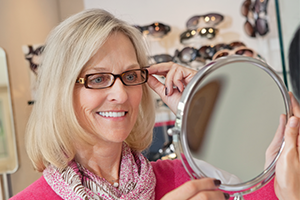
Shape Up: Find The Best Frames for Your Face

Choosing the perfect eyeglass frames can be much harder than you think, as there are several factors to consider. Style, shape, color, and material all play important roles, but determining your face shape is the key to making the right decision.

Most people fall into four face shape categories: heart, round, square, and oval. Let’s break down each face shape to learn which frames will suit you best.

Heart-Shaped Faces
Heart-shaped faces resemble the shape of heart in that the widest part of the face is at the top and the narrowest part is at the bottom. Characteristics to look for include a wide forehead, high cheekbones, and a narrow/pointed chin.

The best frame shapes for heart-shaped faces include rectangle, round, oval, wayfarer, aviator, and square. Styles you’ll want to stay away from include embellished, top heavy, and wide top frames.

Round-Shaped Faces
Just like the name sounds, round-shaped faces are circular, full, and without strong lines and angles. Round-shaped faces will have a wide forehead, full cheeks, and a rounded chin.

Round-shaped faces can pull off several styles including rectangle, square, cat-eye, wayfarer, aviator, and wrap/shield frames. It’s best to stay away from round or oversized frames.

Square-Shaped Faces
Square-shaped faces typically have strong jawlines and facial features defined by strong angles. Square-shape face features include a wide forehead, broad cheeks, and a boxy jawline.

Rectangle, square, cat-eye, wayfarer, aviator, and wrap/shield frames are the most flattering frames for square-shaped faces; while boxy, oval, and heavy brow frames should be avoided.

Oval-Shaped Faces
Oval-shaped faces are very balanced and create the ideal shape for most frames. Oval-shaped faces have a narrow forehead, high cheek bones, and a narrow chin.

Recommended frame styles for oval-shaped faces include rectangle, round, square, cat-eye, wayfarer, and aviator. Oversized frames are the only style oval faces should shy away from.

Once you’ve identified your face shape, play around with the recommended styles in different colors and materials. When you plan to choose your frames at our office, we recommend bringing a family member or friend to provide feedback when you try frames on. And trust your gut. Only you can exude the confidence to rock the frames you love!

Monday, October 13, 2014

Nearsighted vs. Farsighted

If you find yourself squinting to see street signs, the computer screen at work or a picture hanging across the room, it’s likely you are nearsighted. Maybe you have to hold a book far away to read it, have trouble reading the fine print on medicine labels or reading a map. If that’s the case, it’s likely you are farsighted.

To put it simply, nearsightedness is when a person can see better close up than far away and farsightedness is when a person can see better far away than close up.

In normal vision, light enters the eye and is perfectly focused onto the retina, providing a clear view, no matter how near or far the object in view is located. Nearsighted vision focuses on an image before it reaches the retina, often caused when the curve of the cornea is too steep. Just the opposite, farsighted vision focuses on an image behind the retina, occurring when the cornea is too flat or the eye is too short.

Both nearsightedness and farsightedness are frustrating, interfere with daily activities and quality of life, but there is good news. Both conditions can be corrected with eyeglasses, contact lenses or surgery. The best approach can be determined by your optometrist.

Want to see clearly at any distance? Call our office today and we’ll get you setup with the appropriate corrective action before your vision continues to deteriorate. 

Monday, October 6, 2014

My First Eye Exam: What to Expect?

Whatever the reason may be, you’ve decided it’s time to visit an optometrist. Good for you! But now you’re wondering, what happens next? Here’s a basic rundown of what to expect:

Prepare. You’ve made an appointment for a reason. Be prepared with a list of questions for your optometrist. Know your (and your family’s) medical and vision history. Be open on the reason for your visit.

Test. Next, your optometrist will perform a series of tests. These tests will determine how clearly you can see, the overall health of your eyes, and your eye pressure. Depending on the type of test, your optometrist will use the following tools to assess your vision: letter charts, lights, color patterns and eye drops to dilate your pupils.

Review.
Following your eye exam, your optometrist will review the results of all of the tests and provide an assessment of your vision, preventative measures, and next steps.

Now that you know the basics, it’s time to call our office to schedule your eye exam. We’re happy to answer any questions you have and look forward to seeing you soon!